
The physics of the gentle art
Jiu Jitsu promises that technique can beat size and strength. Scientific Jiu Jitsu shows you why it works, from leverage and base to momentum and skeletal frames, so every technique you learn costs you less effort.
Jiu Jitsu is one of the very few places where being told you’re really strong is an insult.
From the book, Chapter 7
When someone says you’re strong, they mean you muscled it. That works for a while, but muscles run on fuel. A smart opponent lets you burn yours, then their technique takes over once you’ve gassed out.
A frame built from bone holds their weight for free. A longer lever makes the same pull count double. Learn the science underneath a technique and you stop paying for it with energy you’ll need later in the round.
Three sciences, one gentle art
Traditional classes teach the move. Principles-based classes teach the idea behind it. Scientific Jiu Jitsu goes one level deeper and asks why the idea works.
Physics
Your body and your opponent’s as masses: force, leverage, momentum, and where the center of mass sits over the base.
Mechanics
How bones, joints and tendons fit together, which way each joint is built to move, and which way it isn’t.
Biology
The living system: your energy, your breathing, your gas tank, and how to drain theirs before you drain your own.
The laws you’re already fighting with
Each one is explained in plain language and then put to work on a real technique. You don’t need a science background. If you cringed through physics at school, this might be the version that sticks.
Mass
The reason weight categories were invented
Mass is how much of you there is, and weight is gravity pulling on it. A heavy opponent and a light one both make your life hard, just in different ways.
Force
Use the force, Luke
Force grows with mass and with acceleration. That’s why a punch beats a push, and a big person’s punch beats a small person’s.
Leverage
Quite literally a force multiplier
Don’t push harder; find a longer lever. Grip the wrist, not the elbow. On top in side control, sprawl long instead of hugging tight.
Stability
A very stable Jiu Jitsu genius
You stay up while your center of mass sits over your base. On top, go low and wide. From the bottom, move their center of mass outside their base.
Momentum
Things in motion like to stay in motion
In the pendulum sweep, swing the leg first. The momentum carries you both past the tipping point and gravity finishes the job.
Frames
Jiu Jitsu gets under your skin
Let their weight rest on a structure of bones instead of holding it off with muscle. Then hip-escape with plenty left in the tank.
Shibumi
Effortless action
If a technique feels like hard work, something’s off. Look for a better grip, a different angle or a stronger frame before you add force.
Start free, then go deeper
The curriculum is a video library organized by principle and by position. Every lesson pairs the technique with the science that makes it work.
Free lessons
For anyone curious
- A sample of videos from the curriculum
- At least one full principle, explained and applied
- New lessons by email
- A discount on the book when it launches
Full curriculum
For instructors and self-learners
- The complete video library
- Foundations, positions and principles modules
- Key points and common mistakes for each technique
- New lessons as they’re added
My students
For people who train with me
- Full access at no charge
- Review what we covered in class, any time
- Ask me for your access code on the mat
The book, being written now
This book is for my fellow warrior geeks, and for the younger me, who spent too long blindly repeating techniques before I thought to apply my science background to them.
It covers the physics, mechanics and biology behind Jiu Jitsu. Along the way it borrows from Taoist philosophers, Archimedes, Galileo and Sir Isaac Newton, with conversions into cheeseburgers and bald eagle wingspans for my American friends. The techniques sit at a basic blue-belt level, because the basics are everything.
Anyone with a free account gets a discount when the book launches. I’m also looking for a small group of early readers to try the drafts on the mat and tell me what works and what doesn’t.
Science student first, black belt later
I’m Stuart Langley. Long before I tied a belt, I was a nerdy student of physics, chemistry and maths, the kind who can’t accept something without knowing why.
My first Jiu Jitsu instructor was Roger Gracie, which is where my belief that the basics are everything comes from. Training with Demian Maia taught me to relax every part of my body that isn’t doing the work. Scientific Jiu Jitsu is how I make sense of all of it, and how I teach.
- Rank
- Brazilian Jiu Jitsu black belt
- Teaches
- The why behind the technique
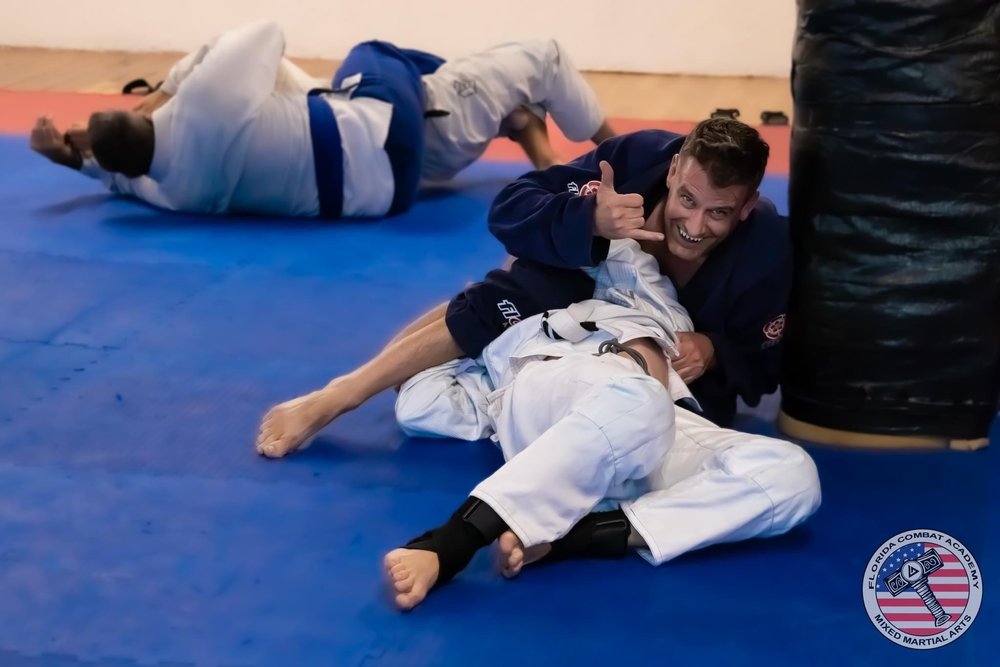
Trained with world champions in Brazilian Jiu Jitsu and MMA
- Roger Gracie
- Demian Maia
- Royce Gracie
- Royler Gracie
- Rodrigo Gracie
- Clark Gracie
- Maurício “Shogun” Rua
- Rodrigo “Comprido” Medeiros
- Felipe Costa
Start with the free lessons
Create a free account to watch the sample lessons and lock in a discount on the book when it launches.